
US and China discuss AI safety plan ahead of Trump-Xi summit
US and Chinese officials proposed a new AI incident notification mechanism during New York talks ahead of the Trump-Xi summit. The discussions also focused on operationalizing a trade board to manage tariff truces expiring in November.

Top officials from the United States and China have engaged in high-level discussions in New York to establish a framework for artificial intelligence safety, a move that sets the stage for a critical summit between President Donald Trump and Chinese leader Xi Jinping later this week. Treasury Secretary Scott Bessent announced on Sunday that the two nations discussed creating a 'notification mechanism' for AI incidents that could threaten national security, marking a significant step in managing the risks associated with rapid technological advancement. These talks, described by Bessent as successful, also addressed ongoing trade negotiations, including the operationalization of a new Board of Trade designed to identify goods for potential tariff adjustments before the current truce expires on November 10.
Quick summary
- US Treasury Secretary Scott Bessent and Chinese Vice Premier He Lifeng held daylong talks in New York covering AI and trade.
- The US proposed a bilateral 'notification mechanism' to alert each other of AI incidents with national security implications.
- Officials agreed to operationalize the U.S.-China Board of Trade to evaluate non-sensitive goods for potential tariff relief.
- The discussions precede the Trump-Xi summit in Washington, where AI safety and trade truce extensions are expected to be key agenda items.
- Chinese state media described the exchanges as constructive but did not explicitly confirm the specific US proposal for an AI alert system.
What happened
United States Treasury Secretary Scott Bessent emerged from daylong meetings in New York to announce that the US and China have discussed the creation of a new 'U.S.-China AI Dialogue.' Central to this proposal is a notification mechanism intended to allow both countries to alert each other regarding artificial intelligence incidents that rise to the level of national security. Bessent emphasized the importance of transparency, stating that moving from opaque practices to greater clarity between the world's top two AI powers is essential for managing cross-border technological activities.
The meetings, which took place at JPMorgan Chase headquarters, also involved U.S. Trade Representative Jamieson Greer, who detailed progress on trade mechanisms. Greer stated that the two sides have 'operationalized' the U.S.-China Board of Trade, a framework aimed at identifying a 'critical mass of goods' that could be treated separately in future trade measures. These goods include consumer products and low-tech items from China, and energy, agricultural, and medical products from the US. While Bessent characterized the talks as laying the groundwork for economic results, Chinese Vice Premier He Lifeng and chief trade negotiator Li Chenggang did not offer separate comments to reporters upon leaving the venue.
How we got here
The diplomatic engagement in New York builds on a series of high-stakes interactions between the two administrations over the past year. Earlier this year, President Xi Jinping hosted President Trump in Beijing, where they discussed pathways for economic collaboration and technological governance. That visit resulted in an agreement for China to purchase Boeing jets and US agricultural goods in exchange for lower tariffs, establishing a fragile but functional trade truce. However, tensions have persisted regarding export controls on advanced chips and semiconductor manufacturing equipment, which have significantly hindered Chinese AI companies.
- May: President Trump visited Beijing, leading to agreements on trade adjustments and initial discussions on AI collaboration.
- Recent days: Prominent AI executives and researchers issued warnings about the potential existential risks of unregulated artificial intelligence.
- Sunday: Treasury Secretary Bessent and Vice Premier He Lifeng met in New York to finalize preparatory talks for the upcoming summit.
- Upcoming: Presidents Trump and Xi are scheduled to meet in Washington, D.C., for a summit focused on economic and technological issues.
Who are the involved parties
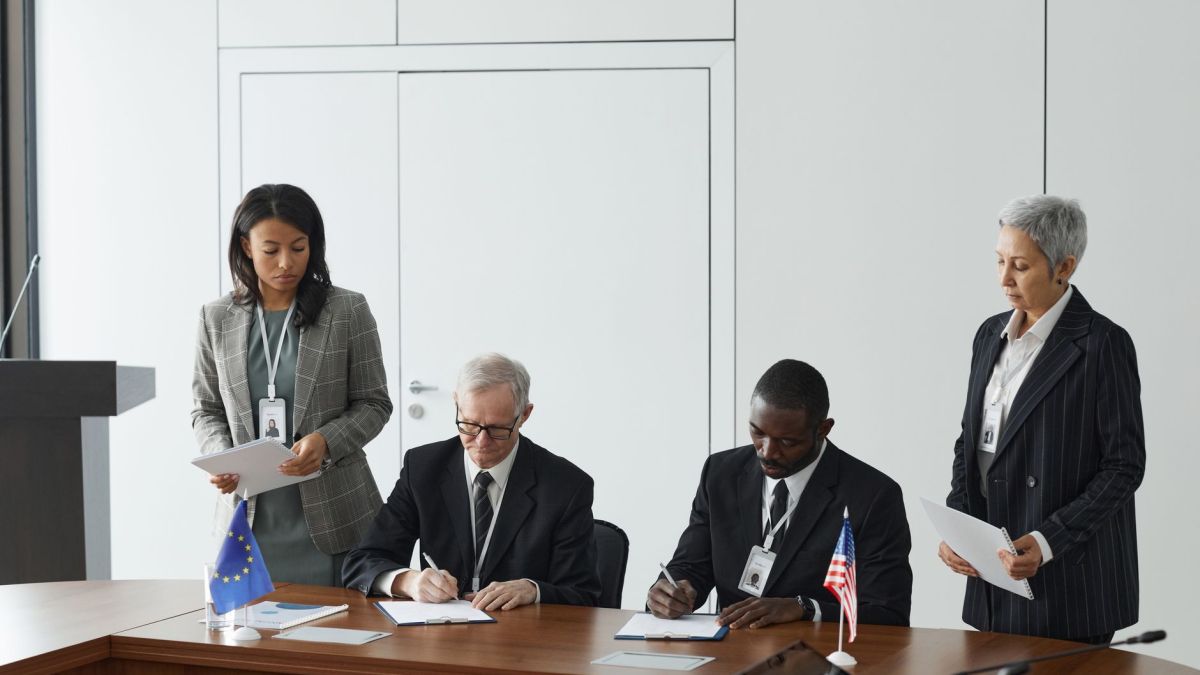
The negotiations involve senior government officials from both nations who are tasked with managing the complex economic and technological relationship between the US and China. On the American side, Treasury Secretary Scott Bessent and U.S. Trade Representative Jamieson Greer led the discussions, focusing on national security and trade policy. Their counterparts in the Chinese delegation included Vice Premier He Lifeng and Li Chenggang, the country's chief trade negotiator. These officials represent the primary channels for diplomatic and economic dialogue between the two governments.
The private sector also plays a visible role in the broader context of these discussions. High-profile corporate leaders, including JPMorgan Chase CEO Jamie Dimon, Citigroup chief Jane Fraser, OpenAI CEO Sam Altman, and Nvidia chief Jensen Huang, are expected to attend a state dinner during Xi's visit to Washington. Their presence underscores the intersection of corporate interests and national policy in the AI and technology sectors, as these companies operate at the forefront of the global race for technological dominance.
What the parties and sources say
US officials have framed the AI discussions as a necessary step toward stability and transparency. Bessent stated that the talks help lay the groundwork for President Trump to advance America's economic interests and deliver results for the American people. He highlighted the need for a structured approach to managing AI risks, contrasting the US position with the more cautious stance advocated by some industry leaders who have called for stricter regulations. Trump himself has largely dismissed concerns about AI risks as a 'hoax,' arguing that the US must maintain its technological edge over China.
In contrast, Chinese state news agency Xinhua provided a more general account of the meetings, describing them as 'candid, in-depth and constructive exchanges on key economic and trade issues.' Notably, the Xinhua report did not explicitly mention the US proposal for a specific AI notification mechanism, instead stating only that the two sides had discussed AI. This divergence in messaging highlights the ongoing diplomatic caution and the differing public narratives surrounding the technical details of the bilateral agreements.

Explainer
The proposed 'notification mechanism' for AI incidents functions similarly to historical military hotlines or crisis communication channels. In the context of artificial intelligence, it would allow the US and China to rapidly share information about significant technological anomalies or security threats arising from AI systems. This concept is part of a broader 'AI safety' framework, which involves establishing guardrails, standards, and cooperative protocols to mitigate the risks of advanced automated systems causing unintended or catastrophic consequences.
The 'Board of Trade' mentioned in the talks is a diplomatic tool designed to manage tariff disputes by creating a list of 'non-sensitive' goods. By identifying products that do not pose national security risks, such as basic consumer items or agricultural goods, the two nations can create a stable zone of commerce that is insulated from broader geopolitical tensions. This approach allows for continued economic exchange even while more contentious issues, such as advanced chip exports and rare-earth materials, remain under strict control or negotiation.
Impacts and why it matters
The establishment of an AI safety dialogue between the US and China carries significant implications for global technology governance. As both nations compete for leadership in artificial intelligence, the risk of accidental escalation or security breaches increases. A formal channel for communication could help prevent misunderstandings and provide a structured response to potential incidents, thereby reducing the likelihood of a technological conflict. This is particularly important given recent warnings from industry experts that AI could pose sweeping new threats if left unregulated.
Economically, the operationalization of the Board of Trade is crucial for stabilizing global markets. With the current trade truce set to expire on November 10, the ability to identify and protect non-sensitive goods from tariff hikes provides a buffer against renewed economic friction. This stability is vital for supply chains and consumer pricing across various sectors, ensuring that the intense geopolitical competition does not disrupt the flow of essential goods and services between the world's two largest economies.

What comes next
The immediate focus shifts to the summit between President Trump and President Xi Jinping in Washington, D.C., scheduled for later this week. Artificial intelligence safety and the extension of the trade truce are expected to be central topics of discussion. Both delegations have agreed to continue talks on the AI dialogue framework, suggesting that the New York meetings were a preparatory step rather than a final conclusion. The outcomes of the summit will determine whether the proposed notification mechanism moves forward and if the November 10 tariff deadline will be extended.
Market analysts and trade experts will closely monitor the statements from both leaders regarding the Board of Trade and the specific goods included in the 'non-sensitive' category. Any formal agreement on these points could provide immediate relief to businesses operating in the affected sectors. Furthermore, the attendance of major tech and financial executives at the state dinner signals that the private sector is closely watching for signals of regulatory clarity and market stability in the US-China relationship.
Quick questions
What is the AI notification mechanism proposed by the US?
It is a system for the US and China to alert each other about artificial intelligence incidents that could impact national security. The goal is to increase transparency and prevent misunderstandings between the two leading AI powers.
When is the current US-China trade truce set to expire?
The current suspension of heightened reciprocal tariffs is scheduled to expire on November 10. Officials are discussing the operationalization of a Board of Trade to manage goods that might be exempt from future tariffs.
Who are the key officials involved in these talks?
On the US side, Treasury Secretary Scott Bessent and U.S. Trade Representative Jamieson Greer led the discussions. On the Chinese side, Vice Premier He Lifeng and chief trade negotiator Li Chenggang participated in the meetings.
Sources consulted
Written with the help of artificial intelligence from the sources above. Found a mistake? Let our editors know.
Read next

U.S. proposes AI alert system with China ahead of Trump-Xi summit
The United States proposed an artificial intelligence safety notification mechanism during ministerial talks with China in New York. Treasury Secretary Scott Bessent announced the initiative ahead of the upcoming Washington summit between President Donald Trump and Chinese leader Xi Jinping.

Croatia vs Spain: Nations League preview, lineups and stakes
Croatia host Spain at Stadion Poljud in Split on Tuesday, October 6, in the UEFA Nations League 2026-27 Group A3. Spain arrive with a perfect record and a 41-match unbeaten run, while Croatia look to respond after their heaviest defeat in history.
MRVL stock: Marvell shows 2nm optical links, expands AT&S deal
Marvell Technology (MRVL) presented what it calls the industry's first 2nm optical interconnect demonstrations at ECOC 2026 and expanded its collaboration with AT&S to secure advanced IC substrate capacity for future AI and cloud infrastructure products.